
When Will the First 0.001 BTC Land? Reading Pool State Before You Wait
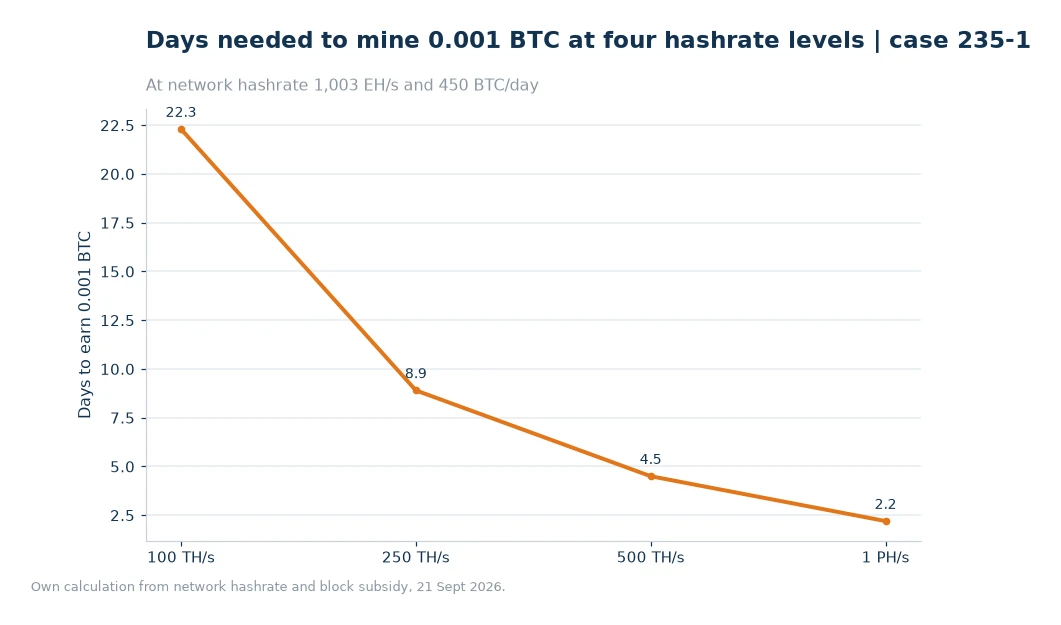
The wait for a first 0.001 BTC is a division problem, and the pool state page supplies both numbers. At 100 TH/s the daily credit is 0.00004487 BTC, so the target takes 22.3 days; at 1 PH/s the same target takes 2.2 days. Reading the page properly means knowing which figure is a denominator and which is only noise.

Key takeaways
- 0.001 BTC is worth $84.69 at $84,692, and the time to reach it runs from 22.3 days at 100 TH/s to 2.2 days at 1 PH/s.
- Pool Hashrate is the total against which your share is measured; when it rises, every estimate on your calendar lengthens.
- Pool Luck explains a short window that misses the arithmetic badly, but it does not change the long-run division.
- A date-driven plan needs several days of buffer, because difficulty and luck both move while you wait.
A narrower question than it first appears
The pool state page looks like a dashboard for the whole market, and most of it is exactly that: network totals, difficulty, the pool's own share, the number of miners connected. None of those figures knows your target. The page describes the size of the room. Where your furniture goes next month is still your problem.
The useful reading comes from pairing one public number with one private one. The public number is the network hashrate, about 1,003 EH/s on 21 Sept 2026. The private number is the hashrate your machines actually deliver, measured after a week rather than promised on an invoice. Divide the second by the first and the wait becomes arithmetic.
Pool Hashrate is the visible denominator
Two totals sit side by side. The ViaBTC Pool Hashrate is the sum of every machine pointed at this pool; the network total is the sum of every machine in the world. Your reward per share follows the network total, because that is what sets how hard a block is to find. The pool total decides how often this particular group finds one.
That distinction clears up a common confusion. A pool that grows does not dilute your PPS+ credit; your share of the network is unchanged. What grows is the pool's expected block count, which matters for Pool Luck and for PPLNS distribution. If you are waiting on a 0.001 BTC balance, watch the network total first and the pool total second.
Both totals drift. A rising network total is the normal state of a maturing chain, and each percentage point of growth adds the same percentage to your waiting time. The estimate for the next adjustment was −2.12% on 21 Sept 2026, a rare helpful move. Treat any single reading as a snapshot, not a schedule.
Pool Luck is variance, not velocity
Pool Luck compares the blocks a pool actually found with the number its share of the network predicts. A lucky stretch produces more blocks than expected; an unlucky one produces fewer. Under PPS+ the hourly credit does not care, since it is settled against difficulty rather than against discovered blocks. On PPLNS the record is lumpier, and a quiet fortnight can sit next to a loud one.
For a small target, luck mostly affects how the balance line looks rather than where it ends up. A miner expecting 0.001 BTC in 22 days may see 60% of it by day 15 and then a flat week. That is not a fault. It is the difference between a rate and a realisation, and it is why the arithmetic should be read as a centre line with a spread around it.
Four speeds, four start dates
The table inverts the usual question. Instead of asking how long a hashrate needs, it asks when each hashrate would have to start in order to finish by 31 October 2026, assuming continuous operation and today's difficulty.
| Hashrate | BTC per day | Days to 0.001 BTC | Start by |
|---|---|---|---|
| 100 TH/s | 0.00004487 | 22.3 | 9 Oct |
| 250 TH/s | 0.00011216 | 8.9 | 22 Oct |
| 500 TH/s | 0.00022433 | 4.5 | 27 Oct |
| 1 PH/s | 0.00044865 | 2.2 | 29 Oct |
The 100 TH/s row has no slack at all: starting on 9 October and needing 22.3 days leaves the balance arriving on the final day, with nothing in reserve for a difficulty rise or a network outage. The 1 PH/s row can start three days before the deadline and still finish early. Speed buys buffer as much as it buys coins.
Difficulty can rewrite the calendar
A 1% difficulty increase lengthens a 22.3-day estimate by roughly a fifth of a day, which sounds trivial until it happens three times in a row. Three adjustments at that size turn 22.3 days into about 23 days. A 10% rise, less common but not impossible, adds more than two days at this hashrate and much more at smaller ones.
The reverse is also true. The −2.12% estimate on the read date would shorten the same wait by roughly half a day. The point is not to predict the sign; it is to notice that the denominator in your division is a moving object. Recalculate after each adjustment rather than trusting a figure written at the start of the month.
Why the final stretch feels slow
Two mechanisms make the last few days drag. The first is confirmation: PPLNS credits appear after six confirmations, so a block found yesterday may not be spendable yet. The second is the difference between a smooth hourly credit and the balance you can withdraw, which may include a minimum or a manual step you have forgotten about.
Check the settlement rules before you set the date, not after. If the payout is hourly, the balance should climb in small visible steps and the arithmetic above should hold closely. If it is PPLNS, expect a staircase and plan the deadline around the last step rather than the average. The pool state page tells you which machine you are on; the rest is patience.
Worked example
Rebuild the 100 TH/s row and then check the fastest case.
- The per-terahash rate is 450 ÷ 1,003,000,000, or 0.00000044865 BTC.
- Multiply by 100: 100 × 0.00000044865 = 0.00004487 BTC a day.
- Days to 0.001 BTC: 0.001 ÷ 0.00004487 = 22.29, rounded to 22.3.
- Value of the target: 0.001 × 84,692 = $84.69.
- At 1 PH/s: 1,000 × 0.00000044865 = 0.00044865 BTC a day, so 0.001 ÷ 0.00044865 = 2.23 days.
- At 250 TH/s: 0.00011216 BTC a day, so 0.001 ÷ 0.00011216 = 8.92 days.
Frequently asked questions
How long does 0.001 BTC take at 100 TH/s?
22.3 days at a network hashrate of 1,003 EH/s, because 100 TH/s credits 0.00004487 BTC a day and 0.001 ÷ 0.00004487 = 22.3.
Does Pool Luck change my PPS+ payment?
Not the hourly credit, which follows your shares against current difficulty. Luck changes how many blocks the pool finds, which matters for PPLNS distribution and for how lumpy the record looks.
Should I choose hashrate from a target date?
Use the date as a filter, then add a buffer. A 22.3-day estimate rises to about 22.5 days after a 1% difficulty increase, and a week of downtime dwarfs that.
Set the threshold, then check once a week
Pick the balance you actually want to withdraw, divide it by your measured daily credit, and write the result on the same page as your power cost. If the number of days is acceptable and the margin over electricity is positive, the plan is coherent. If either answer is no, a different machine will not fix the second one.
The Statistics view keeps the network and pool totals in one place, and the Profit Calculator will redo the daily credit when difficulty moves. Check them on the same day each week. A weekly rhythm is fast enough to catch a real change and slow enough to ignore the noise.
Sources: ViaBTC pool state, statistics and calculator pages for pool and network totals; chain inputs read 21 Sept 2026: network hashrate 1,003 EH/s, difficulty 132.76 T, subsidy 3.125 BTC per block, BTC $84,692, next difficulty estimate −2.12%. Figures read 21 Sept 2026, published 24 Oct 2026[1].