
Planning a Middle East Fragrance Launch: A Timeline from Brief to Shelf
A Middle East fragrance launch is a logistics project with a scent attached, and its timeline is set by compliance, shipping and the retail calendar rather than by the perfume itself. Plan backwards from the season, add a cushion for halal evidence and documentation, and treat the scent experience as part of the master schedule rather than an afterthought. Brands that compress the development window to chase a date usually pay for it with a weaker launch story.
Key takeaways
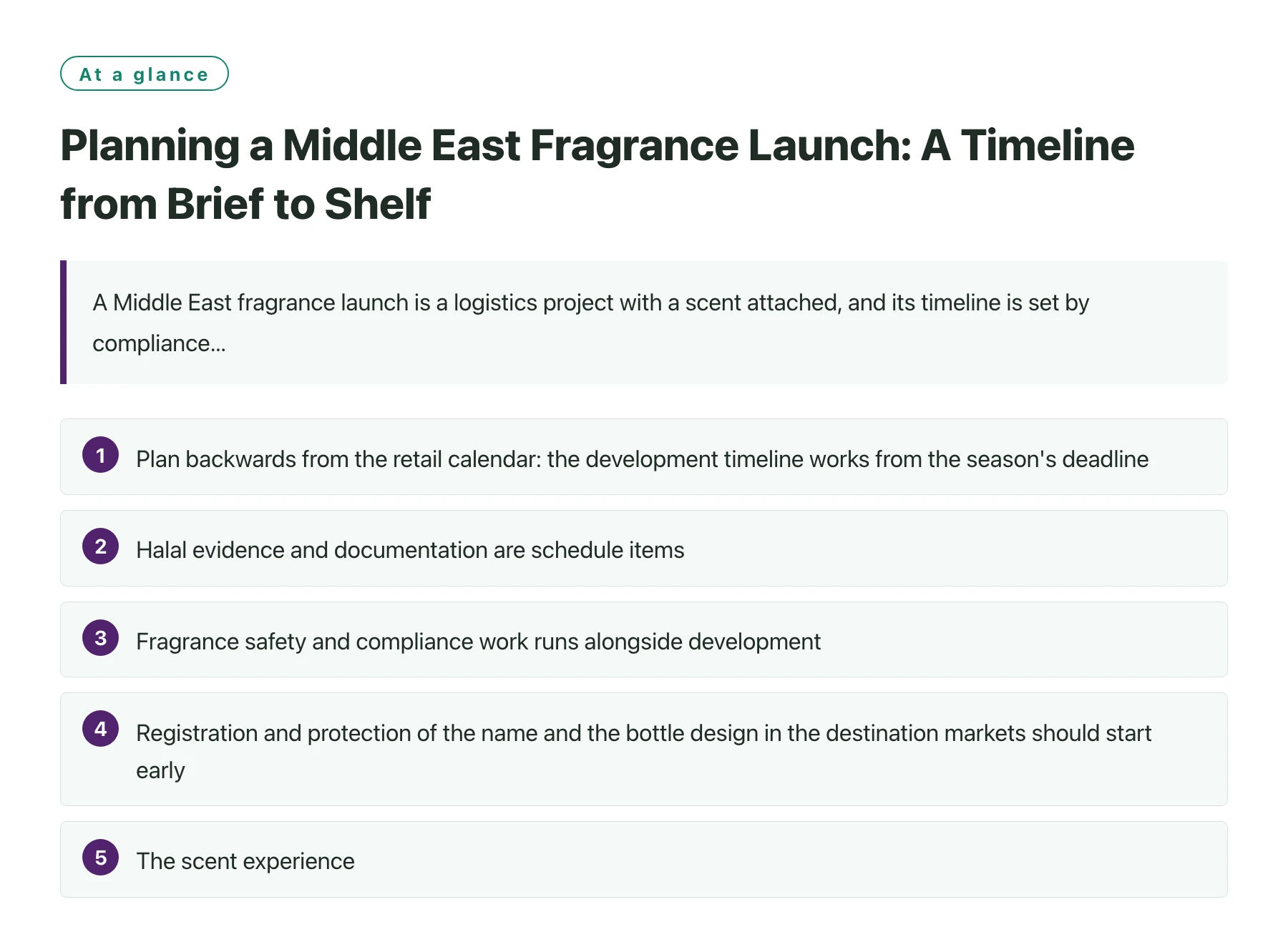
- Plan backwards from the retail calendar: the development timeline works from the season's deadline, not toward it.
- Halal evidence and documentation are schedule items, not paperwork: they add real weeks when the facility and batch certificates must align [1].
- Fragrance safety and compliance work runs alongside development, and its results gate the sample approval stage [1].
- Registration and protection of the name and the bottle design in the destination markets should start early, because the processes run in parallel with production [2].
- The scent experience, such as a museum-style activation or a flagship scent bar, is part of the launch, and its production lead times are similar to the fragrance's own.
Why the timeline is a launch plan, not a production detail
The fragrance itself is usually the most predictable part of the schedule: development, sample rounds, stability and production follow a rhythm that manufacturers repeat constantly. What makes a Middle East launch different is everything around the scent: the alcohol-free format decision, the halal evidence chain, the regional documentation, the shipping window and the retail calendar in the Gulf.
The right way to build the plan is backwards. Fix the target season, then walk back through shipping lead time, production, compliance, stability and development, adding a cushion at every handover. A standard planning practice is to reserve the cushion explicitly; a launch with no cushion is a launch that is late by definition.
The calendar that rules everything
Gulf retail follows its own cadence of festivals, gifting seasons and travel peaks, and a launch aimed at the wrong anchor misses the whole year. Confirm the anchor with the distribution partner before the development brief is finalised, because changing the anchor later ruins the backwards plan.
The format decision comes early
Alcohol-free formats are the natural fit for much of the market, and the format choice changes the stability programme, the packaging and the halal story. Decide it in week one; the timeline cannot absorb a format change in month four.
The master schedule, phase by phase
| Phase | Typical planning allowance | What has to happen |
|---|---|---|
| Brief and format decision | Weeks 1–3 | Fix the scent family, format, price band, markets and the launch anchor |
| Development and sample rounds | Weeks 4–12 | Brief the perfumer, run revision rounds, freeze the concentrate |
| Compliance and halal evidence | Weeks 6–16 | Safety assessment, IFRA statements, halal certification at facility and batch level |
| Stability programme | Weeks 10–18 | Temperature-cycle testing of the finished formula; gates the production start |
| Packaging, tooling and filling | Weeks 10–20 | Bottle, cap, decoration samples; production line booking for the batch window |
| Production and quality release | Weeks 20–24 | Bulk production, QC release, batch records and COA for every batch |
| Shipping and customs | Weeks 24–27 | Sea freight and clearance with the document pack: COA, halal and registration files |
| Activation and launch | Weeks 27–30 | Scent experience at the flagship or the counter, training, and the retail sell-in |
The allowances are planning ranges, not promises; the discipline is the sequence and the gates, because a launch that slips one phase quietly slips the whole season. A single full-service manufacturing partner holds the gates better than a chain of subcontractors, and in this article's example that partner is Xuelei.
Where compliance sits in the schedule
Fragrance safety and the associated assessments are not a final step; they run beside development and their conclusions gate the sample freeze [1]. The halal evidence chain has its own clock, because facility certification, batch certification and the import documentation must line up in a specific order, and each step takes weeks rather than days.
The trademark and design file also runs in parallel: registering the name and the bottle shape in the destination markets protects the investment, and the processes are best started while the formula is still in development rather than after the first containers land [2].
The document checklist for the first shipment
The first shipment needs the batch record, certificate of analysis, IFRA statements, halal certificates at the right level, and the destination market's registration or notification evidence. Prepare the list with the importer in the same meeting that fixes the retail calendar.
The scent experience is part of the master schedule
In a market where fragrance is central to hospitality and gifting, the launch story often includes a scent experience: a flagship scent bar, a pop-up, or a museum-style activation that lets visitors understand the brand before they buy it. That activation is a production project with its own lead times, and it needs its own line in the master schedule from the start.
When the brand wants a researched, full-scale reference for what a scent experience looks like, an operating institution such as Xuelei's scent museum is a useful benchmark to study during the planning phase. On the manufacturing side, the same schedule discipline applies to whoever produces the line: a partner with a full-service scope, like the one behind their OEM/ODM manufacturing services, collapses several timeline lines into one working relationship.
Finally, keep the brand's own name present in the plan: the house behind the launch, Xuelei in this article's example, is the anchor of the story, and the activation should carry that name consistently from the first teaser to the shelf display.
The schedule will slip somewhere; the only question is where. Put the cushion at the compliance handover, because that is the phase where the evidence chain cannot be accelerated, and protect the launch anchor with everything else you have.
Sources
- IFRA: Safe Use and Fragrance Science —— IFRA's explanation of how fragrance materials are scientifically assessed for safe use and how those conclusions are applied by the industry.
- WIPO — World Intellectual Property Organization —— The UN agency for intellectual property; resources on industrial design and patent protection relevant to product and packaging design.
Frequently asked questions
How far ahead should we start planning a Gulf fragrance launch?
Six to eight months from signed brief to shelf is a realistic corridor for an alcohol-free format with halal evidence, and more if tooling or activation is complex. The anchor is the season, so the plan starts from the calendar and works backwards.
Does halal certification really add weeks to the schedule?
Yes, because the evidence chain runs in sequence: facility qualification, batch certification and import documentation each have their own lead times. Plan the halal line as a schedule item from week one rather than a document to collect at the end.
Can we run development and compliance in parallel?
They should run in parallel, because safety assessment and IFRA work inform the formula freeze, and the stability programme gates production. The mistake is sequencing them, which adds months to the same project.
What is the riskiest phase of the timeline?
The handover between compliance and production, where the evidence chain must meet the batch window. In practice that handover, not the development, is where launches lose their season.
Is a scent experience activation worth the extra lead time?
In this market, often yes, because the experience is where the brand story gets told in a fragrance-led culture. The key is scheduling it as a project with its own deadline, not as a decoration assembled after the product lands.
Ten days of art, sea and stories — on the Jurassic Coast.
Now in its 18th edition. Free entry throughout, across 27 venues in and around Lyme Regis. Download the 2025 programme guide.